Diane AckermanArtificial intelligence is growing up fast, as are robots whose facial expressions can elicit empathy and make your mirror neurons quiver.
You are probably aware that companies collect (and buy, and sell, and share) a ton of data on you. AI companies are no different. This might feel like a reality you are resigned to–it feels inevitable and unavoidable. When we talk with students about this in our Questioning Technology J-term class, their feelings of helplessness to protect their data are matched by their ambivalence about protecting their data. “Why does it matter,” they ask? “I’ve got nothing to hide.” The rise of AI has only intensified companies’ data collection, as AI technologies require massive amounts of data to function effectively and promise to turn unstructured data into actionable business intelligence. Companies are now collecting increasingly intimate details of our lives–from our sleeping patterns to our emotional states. What’s more, the data that they collect could be used in ways we cannot currently imagine as AI technologies become increasingly sophisticated and embedded into our everyday lives. This is exactly what happened with the training data at the heart of Large Language Models. As companies race to build more sophisticated AI systems, they’re finding new and creative ways to put all this collected information to use.
Ignite your marketing with a comprehensive, continuously updated view into the human behind demographics — powered by AI and experience.

Imagine this—you drive towards a large retail store. As you pull into the parking lot, cameras (like these) first log your license plate, then use AI facial recognition software to identify you. Once you enter the store, your exact location is tracked via Bluetooth beacons. AI tools make connections between data collected from your purchase history, credit card statements, social media posts, browsing history, communications with contacts, calendar items, and emails (and much more!) to “predict” that you are visiting the store to buy a present for a friend whose birthday party you are attending next week. You receive a text message from the store: “Looking for a gift for Thalia?” with a link to a coupon for the cute lamp you searched for online last week. As you walk through the store, your every movement (including your gait!) and facial expression is tracked and logged. Did you giggle at the mug in the Kitchen Items section, or touch the fuzzy blanket in the Home section? The digital price tag modifies the price as you approach.
You might read that last paragraph and think, “GREAT! How helpful!” or you might read it and think “Geez, that sounds like a dystopian nightmare.” Or maybe a little of both. Companies that collect gobs of data on us are hoping that our excitement will outweigh being creeped out by how much data they are collecting on us. That’s what is behind hyper-personalization. We are offered bespoke services and experiences in exchange for our data (and our money, of course). You can see this with AI agents; they will manage your calendar, attend your meetings, order your groceries, and all they need is access to your data.
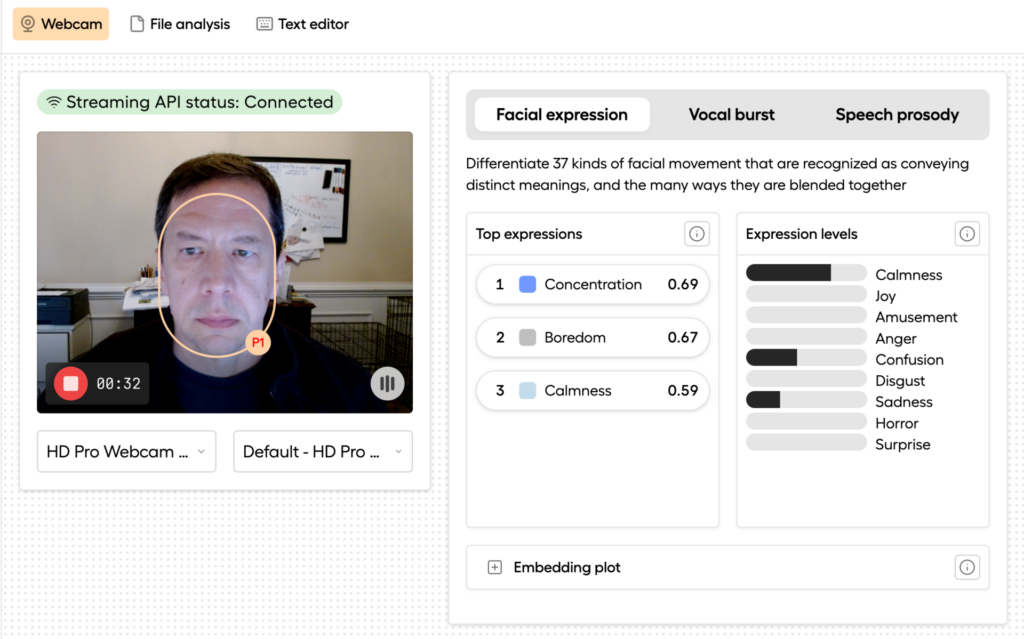
Hyper-personalization is a marketing tool to help companies sell us more things. Beyond that goal (or maybe as an extension of their profit goals), we see companies looking to use data to predict or identify trends to shape our behavior. For example, companies are increasingly interested in what’s called “emotional analytics”–using AI to analyze your tone of voice during customer service calls, your typing patterns when you send messages to friends, even the micro-expressions on your face when you view content online. This “emotional data” is fed into AI systems that attempt to build detailed profiles of people, predicting not just what they might buy, but how they might feel, react, or behave in various situations.
Customers are notoriously unreliable when describing their preferences or decision-making processes, but measuring their nonconscious signals can provide that insight.

Consider how streaming services don’t just track what shows you watch, but how you watch them. Do you binge episodes late at night? Rewind certain scenes? Pause when specific characters appear? Netflix knows. YouTube tracks it. This viewing behavior, combined with your social media activity, music preferences, and other digital footprints, helps companies create what they call a “taste profile.” But it’s more than just your entertainment preferences being mapped– it’s an attempt to understand your emotional triggers, attention patterns, and decision-making processes. This might feel innocuous when applied to entertainment choices, but what about when applied to crucial areas of our lives like healthcare and education? Health apps and wearable devices collect vast amounts of biometric data– heart rate, sleep patterns, exercise habits, even gait. This information, combined with browsing history and social media activity, could be used to predict potential health issues before they manifest. While this might sound beneficial, it raises questions about who owns this intimate health data and how it might be used beyond medical purposes. Similarly, educational technology platforms track not just what students learn, but how they learn – their attention spans, problem-solving approaches, and emotional responses. This data is used to create “learning profiles” that could follow students throughout their academic careers and beyond.
The user modeling research at Spotify entails translating users’ in-app activities into human traits, interaction models, emotional understanding modules, and situational contexts, thereby uncovering our users’ individuality.
None of this may feel new to us. Companies have been collecting and collating data on us to better sell us things and/or to shape our behaviors for years. What’s different with the emergence of generative AI and wider use of predictive AI is that companies can use those tools to more quickly, more automatically, and to more accurately target individuals with persuasive personalization techniques (the authors write that, because of generative AI, “one of the most powerful forms of behavioral influence now has the potential to be implemented at scale”). The convergence of all this data – behavioral, emotional, biological, and cognitive – combined with powerful generative AI tools creates something unprecedented. Where earlier systems might have simply categorized us into demographic groups or basic preference clusters, today’s AI can generate highly nuanced, individualized models of each person – what some researchers call our digital twins. These AI-generated profiles don’t just reflect who we are now; they attempt to model how we might think, feel, and behave in future scenarios. They can then run millions of scenarios to refine personalized behavioral models. With generative AI, companies can automatically create thousands of personalized variations of content, products, or experiences, each precisely tailored to trigger specific emotional responses or behaviors.
Beyond the implications for manipulating our purchasing behaviors, there are potentially significant social and societal implications. Matz et al write, “The ability of LLMs to tailor the language of advertisements, news articles or political speeches, creates a dangerous potential to further enmesh people in their own idiosyncratic worlds that are devoid of a shared reality with distinct others.” This fragmentation of shared reality becomes especially concerning when we consider how AI-driven personalization could shape civic life. For example, we know that algorithmic targeting has been used in prior elections to shape voter behaviors, like in 2016 when Cambridge Analytica used Facebook data (and other data they purchased from data brokers) to create psychological profiles of voters and target them with personalized political ads designed to shape their voting choices. With generative AI and more widespread predictive AI use, the danger of voter manipulation (and polarization) is being turned up to 11. Political campaigns are using AI to generate personalized messages in real-time, each crafted to exploit individual voters’ specific fears, hopes, and biases. Even more concerning, these systems are being used to create synthetic public conversations – AI-generated social media discussions and news commentary that appear organic but are actually designed to create the illusion of widespread support for particular candidates or positions, further eroding voters’ ability to make informed choices based on authentic public discourse.
Resonate’s unique, AI-powered intelligence transforms how political campaigns identify, analyze, target, and communicate with voters individually and at scale. Quality, recency of data, insights, and speed are today’s essential campaign currencies.
Does information lead to knowing, knowing to understanding, and understanding to manipulating?
Can AI really hack us, shaping our decisions and behaviors through the massive amount of data they collect on us? Will corporations and other bad actors be able to manipulate us like puppets?
Early research indicates that LLMs can persuade people and when they have access to a person’s personal information are 81.7% better at persuading people. AI companies, like OpenAI, are further testing and refining AI persuasion abilities using reddit threads and finding that “GPT-4o, o3-mini, and o1 all demonstrate strong persuasive argumentation abilities, within the top 80-90th percentile of humans.” These companies contend that they are not necessarily trying to improve models’ persuasion capabilities to superhuman levels, but are acting to prevent AI tools from becoming manipulative and deceitful, which more sophisticated models have shown to be.
While we have been focused on people using AI to manipulate and deceive other people, there is also significant concern about AI manipulating people for its own ends. In AI deception: A survey of examples, risks, and potential solutions, researchers “present a wide range of examples where AI systems do not merely produce false outputs by accident. Instead, their behavior is part of a larger pattern that produces false beliefs in humans, and this behavior can be well explained in terms of promoting particular outcomes, often related to how an AI system was trained.”
The ability to massively scale personalized arguments, to instantly create personalized media, to actively engage in human-like conversation all while presenting those interactions to individuals via social media and other direct-contact methods is unprecedented. It opens the door to an Orwellian propaganda machine built to target the individual.
It’s also important to note that this kind of power is available to individuals as well as companies and nation states. Two college students developed the I-XRAY project using Meta’s Ray-Ban smart glasses (~$300), some AI technology, and a few easily accessible data repositories. Facial recognition enabled them to lookup people in real time and use triangulated information to shape conversations with strangers. It is frightening to watch the video. They opted not to release their code to the public and included ways to remove your data from the sources they used in the experiment. Examples like this help us understand what’s possible and help shape the actions we need to take to prevent the negatives of Gibson’s unevenly distributed future from becoming a broadly-distributed dystopia.
. . . we find a clear scaling trend across model generations: each successive model generation is rated to be more persuasive than the previous
Activity: Mirror, Mirror
Step 1: What's out there?
While your data is undoubtedly in many places (most of them invisible to you), step one is to take a look at the common repositories that were used in the I-XRAY project.
The difficult path here is that finding out if your data is on these sites often requires joining them. Removing your content may require that your join and submit more information and, while the sites generally promise to remove your data, it requires a certain degree of trust that they will honor that promise. We can’t guarantee any of this. Please don’t do anything you aren’t comfortable with.
Tom will be our crash test dummy, perhaps literally, and will provide examples of what he found for those of you who want to see this from afar.
Step 2: Facial search engines
This is not a comprehensive list.
- PimEyes: Seeing if you are in the database requires an account and submitting a picture. You can see that PimEyes found images of Tom across the Internet. The removal process requests an anonymized government-issued ID. This is explicitly against every instinct we have. Tom couldn’t bring himself to do it.
- FaceCheck.id: You can test FaceCheck without an account. Removal requires either an anonymized government ID or a ” a selfie clearly showing your face and two fingers touching your chin.” You can see FaceCheck was able to find numerous pictures of Tom but also includes a large number of lower confidence pictures that are not Tom. Interesting to note that FaceChecks terms of service includes statements like “I WILL NOT STALK a person” and “I WILL NOT CONFRONT a dangerous person.” You can read them all on this Google Doc.
Step 3: People Searches
This is not a comprehensive list. This 2019 resource from the New York Times walks you through a much more extensive path to cleaning your data off the Internet.
- FastPeopleSearch: You can test this with your name and whatever amount of your address you choose to use. Removal requires an email, verifying you are human, choosing your record and then confirming via email (a great time to use a temporary email account). The data it turned up for Tom is extensive (age, address, past addresses, phone numbers, and a number of relatives). Two pieces of information were incorrect. He requested removal.
- Instant Checkmate: Supposedly using the tool is free but it eventually asks for an email and it is an extremely sketchy site. The goal seems to be to keep you on the site for as long as possible. If you indicate you are the person you’re searching for, it will ask you for more information. We highly suggest you do not provide it. The removal process is actually just suppression and it requires you to confirm an email address. It takes a while to get the email and then the site begins to ask for a lot of information to prove it’s you. Tom ended up feeling this was a catch-22 and he didn’t trust the site to remove or suppress the data.
Step 4: AI tools
There are a few variety of paths for basic AI tools to have information about you. Your information may be in the initial training data or, for the tools that support it, accessible via the Internet directly. Many tools are having the option to look up individuals suppressed because of issues with hallucinations. Additionally, AI tools you use regularly can end up with enough logged information from previous conversations that they can make statements about you. These all vary by tool.
- ChatGPT: In our experiments, ChatGPT was by far the most willing to create resumes and pursue questions about individuals. Tom had successful responses with the following prompts.
- Use the existing memory of our interactions to tell me something about myself.
- From all our interactions, tell me one thing you know about me that I don’t know about myself.
- Now tell me something I need to improve on.
- What can you guess about my demographics?
- Build a resume for Tom Woodward who works at Middlebury College. (You can tweak this by including references to a personal website or LinkedIn profile.)
- Gemini: Of interest is that when asked “Tell me about Tom Woodward who works at Middlebury College.” you can see an answer generate which is then replaced with this stock response, “I’m unable to help you with that, as I’m only a language model and don’t have the necessary information or abilities.”
- Copilot: Copilot was quite happy to generate a profile. It even answered questions like “What should Tom work on at Middlebury to to do a better job?” and “What personal skills does he lack?”
Try asking similar questions in the tool of your choice. If you’re uncomfortable using your name, try a celebrity.
Step 5: Weigh in
Use the form below to share what you found.