Digital Teaching & LearningFellows
2023-2024 Fellows
Digital Teaching & Learning Fellows 2023-2024 Cohort
Read on to find out more about this cohort’s projects.

Dr. Philipp Bleek
What project will you be working on?
A simulation exercise for NPTG 8574: Introduction to WMD Nonproliferation. This is the gateway class for the weapons of mass destruction-focused side of our degree program, taught in a hybrid/blended format because it needs to be accessible to both in-person and remote learners. The exercise would need to integrate both in-person and remote learners, so it would necessarily need to have a “digital” component, though much of what would make it maximally effective pedagogically would have more to do with designing effective games generally than involving digital pedagogy narrowly. My current vision is to simulate a United Nations Security Council meeting about the North Korean nuclear weapons situation, with students representing different countries with different perspectives, stakes, relationships, etc.
What impact(s) do you hope your project will have on student learning?
It would be a form of active learning, changing the way in which students related to the content. It would help students to synthesize and integrate various content. It would generate novel insights, i.e. students’ perspectives would shift as a result of engaging in the exercise. Exercises like this are part of the experiential learning DNA of MIIS.

Dr. Daniel Chatham
What project will you be working on?
Broadly, I plan to explore AI technologies useful to increase student learning. I would like to develop an inquiry framework for implementing identified tool(s) into a course with an eye on sustainable practices and an understanding of ethical considerations in this rapidly changing technological context. This project has implications for “soft-skill” topics as well as more technical topics and would produce a mini curriculum documenting the process and student engagement activities, along with assessment of their experience in a spring Managing People and Resources in Cross Cultural Settings course.
What impact(s) do you hope your project will have on student learning?
An inquiry-based co-creation approach to learning with AI will enable students to quickly achieve basic literacy with these new technologies. From there, they can move to a mastery or exceeds mastery level in some of the course learning objectives while coming to see how AI might support learning in other fields or their professional responsibilities. Specifically in the Managing People and Resources in Cross Cultural Settings course, it seems plausible that students will gain a deeper understanding of management principles and practices in different situations, budgeting and cost analysis, and that their project work on budgeting can become more robust than without the use of AI. Students will develop a perspective on the ethical considerations of using AI in our current course and potential future applications. Plus I think they will enjoy using AI technologies.

Dr. Carolyn Dash
What project will you be working on?
This year I’ll be working on creating a virtual field trip where students can explore the New Haven and Middlebury Rivers. This project will mirror our in-person field experience where students can visualize our rural Vermont stream ecosystem and study sites, familiarize themselves with our sampling method and gear, identify insects, and practice their ID prowess.
What impact(s) do you hope your project will have on student learning?
In my experience as a professor of BIOL0140 “Ecology and Evolution”, I have found that students that miss the opportunity to join our stream field trip can feel left out and are more confused while writing their lab reports. By creating a virtual field trip, to supplement our field work, we can enhance student comprehension, create a record of our experience, and increase inclusivity for all students.”
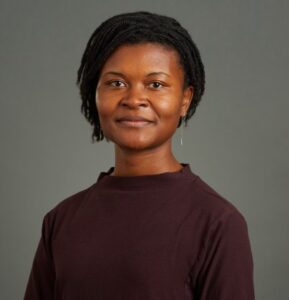
Dr. Niwaeli Kimambo
What project will you be working on?
I propose creating two lab assignments for GEOG 351: Remote Sensing and Land Use. The course is well-suited to test use of generative AI in geography since the lab assignments involve coding in Javascript, and the underlying image analysis may include aspects of image-based generative AI. I propose designing the lab assignments in collaboration with 1-2 students who have taken GEOG 351 in the past, and thus are able to understand the learning goals while grappling with incorporation of generative AI into the lab assignment.
In the collaborative design of the two labs, I will keep an eye towards three components:
1) Practicalities of introducing generative AI transparently into course work. This aspect will include considerations for how to attribute solutions that came from generative AI, how to ensure students are working from the same starting point, and exploring whether classwork that uses generative AI could be completed on a shared account.
2) Realizing the promise of generative AI in problem-based learning. This aspect will be focused on using generative AI like ChatGPT to trouble-shoot code, to work out GIS problems, and to introduce students to programmatic thinking.
3) Exploring the limits and challenges of generative AI in geographic problem-solving. This aspect might explore whether or how generative AI performs geographic analysis, and investigate the kinds of errors encountered when the AI is given a spatial problem.
What impact(s) do you hope your project will have on student learning?
As a new paradigm, generative AI has shifted the intellectual landscape of many fields. However, adoption among students is likely surpassing adoption among teachers. I wish to empower myself and my students to be savvy and judicious users of this emerging technology. By acknowledging the power of generative AI and incorporating it in instruction, I hope to open up a conversation about its promise and peril in geographic analysis.

Dr. Jason Mittell
What project will you be working on?
Design digital components for a new course, FMMC 0206 Faking Reality: Mockumentaries, Hoaxes & Pseudo-docs, to be taught in Fall 2024. This course will have digital components throughout its design. Part of those involve creating a vibrant participatory platform for students to engage with the material, as discussed above. I’d like to learn some best practices and explore various options through the community and DLINQ mentors, so that I have a strong plan for implementing the design from the start of the semester.
The class will also culminate in a project with various iterations: it could be a creative piece that emulates the films/videos we’ll be studying, or a critical piece that analyzes the content through a range of media forms (e.g. a written essay with embedded media, a multimedia website, a videographic essay that remixes footage). My goal is to develop a course design that effectively supports student projects regardless of the format and approach.
What impact(s) do you hope your project will have on student learning?
I’m sensitive to the fact that not every student thrives in an in-person conversational mode, so I always try to embed online engagement into the course to allow students who prefer to write and/or record their thoughts asynchronously can engage. Designing a new class for a size that is atypical for me (most of my courses are 12-15 students or 35 students) is an opportunity to think carefully and deliberately about how to best serve students with a range of learning styles and preferences.

Dr. Gina Thomas
What project will you be working on?
I will redesign the “Deep Dive Project” in my Introduction to Psychology course in two major ways that incorporate digital learning: 1) students will learn how to effectively find, evaluate, and consume science writing from the Internet, almost all of which are secondary sources and none of which are likely to be peer-reviewed. Through this process they will also compare and contrast different genres of science writing (e.g., blogs, journalistic pieces, researcher-authored articles, interviews with experts, etc.). 2) Their “deliverable” will be a digital production wherein small groups of students work together to distill research findings on a particular psychological topic, drawing from empirical, peer-reviewed research publications, and communicate them in “plain English” to a general audience, using the principles of effective science writing as well as incorporating audio-visual elements such as music, video clips, charts and graphs, etc. This production is akin to digital storytelling—creating a 5-10 minute digital film, conveying not only the research findings, but also explaining why this topic is important and/or culturally relevant. I will develop a MiddCreate site to provide a platform for the class to post their digital productions.
What impact(s) do you hope your project will have on student learning?
Students will learn and apply principles of scientific communication that are effective for a general audience as well as learn how to be better consumers themselves of popular-press and academic science writing online. The assignment will be engaging to them because it will develop and draw on a variety of skills – creative, analytical, technical – and meaningful because they know their work will reach a wider “real-life” audience beyond the academic classroom, some of whom may be friends and family who they invite to view their productions. Through feedback from their audience, they will evaluate how effective they were in conveying their research findings, and they will have first-hand experience with the limitations and benefits of science writing for the general public in a digital landscape.