DLINQ is providing a monthly email update containing discipline-specific AI resources. You can update your subscription preference and disciplinary focus at any time using this online form. We encourage you to share the subscription link or this site with interested colleagues.
Discipline
Theme
Search
Designing and governing generative AI for language education
Posted on September 25, 2026This open-access perspective article argues that AI tools built mainly for efficiency and personalization pose three risks in language education: students outsourcing their communicative judgment, AI treating dominant language varieties as the "correct" default, and opaque collection of student data. In response, the authors propose the RAiLE framework, which pairs teaching practices with design features and data safeguards, such as having students accept, reject, or revise AI suggestions and justify their choices, offering multiple options with explanations rather than a single corrected version, and adopting clear data agreements that bar using students' AI logs for discipline or ranking.
How AI Is Changing Foreign Language College Classes
Posted on September 25, 2026College language instructors are increasingly using AI to generate target-language texts and dialogues, simplify difficult materials, create class activities, and give students more chances to practice speaking outside class, uses that are especially valuable for less commonly taught languages where materials are scarce. Instructors at the University of Chicago Language Center and elsewhere stress starting with institutionally supported tools, choosing them for what they enable pedagogically rather than for popularity, and treating AI as a supplement, since it can sound robotic, varies in quality across languages, and can't replace real conversation with other speakers.
Climate-control ChatGPT for EFL writing and AI literacy
Posted on September 25, 2026In a study of 120 undergraduate EFL writers in Jordan, a structured ChatGPT approach that required students to justify and rewrite their own claims improved argumentative writing and critical AI literacy more than standard ChatGPT use or no AI, with gains lasting even when students later wrote without it.
When AI Meets Language Class
Posted on September 25, 2026Scholars from Rutgers University–Newark and Howard University argue that AI guidance focused on efficiency misses what language teaching is really about: meaning-making, voice, and identity. They propose a Position–Design–Enact framework that helps teachers define AI's role, design tasks that invite students to question AI output, and stay attentive to bias and authorship, keeping final language choices in students' hands.
Carnegie Mellon to Lead National Study of AI in Arts Education
Posted on September 25, 2026Right now, every art school is figuring out AI on its own, and Carnegie Mellon wants to change that. With a highly selective National Endowment for the Arts grant, CMU's College of Fine Arts is launching a national study of how higher education is bringing AI into the arts, with benchmarks to help institutions see what their peers are doing and help the arts, in principal investigator Daragh Byrne's words, "lead the national conversation — not follow it."
Academy of Art University Launches MFA in AI-Driven Creative Practice
Posted on September 25, 2026Academy of Art University in San Francisco has launched an MFA in AI-Driven Creative Practice, a 60-unit program offered online and on campus starting Summer 2026. Building on its fast-growing MA in AI Marketing & Design, the degree combines studio practice with venture creation, so students graduate with a pitch-ready business concept.
Generative AI in Higher Music Education: Pedagogy and Ethics
Posted on September 25, 2026This review examines generative AI in university music education, highlighting benefits like personalized learning and creative AI courses alongside concerns about integrity, authorship, copyright, bias, and over-reliance. The author argues that careful course design, teacher preparation, and clear institutional guidance can support responsible adoption.
From AI Acceptance to Co-Creation: A Framework for Art and Design Faculty Creativity
Posted on September 25, 2026Artificial intelligence generated content (AIGC) is increasingly used in art and design education, but research often assumes adoption alone boosts creativity. Integrating TAM and DOI theory, this conceptual study proposes an Acceptance–Practice–Creativity framework for university art and design teachers, arguing that creativity emerges only through sustained human–AI co-creative practice. Because AIGC also risks dependency, copyright issues, and aesthetic sameness, the framework calls for faculty development, process-based assessment, and human-centered AI practice.
AI for the Humanities Videos
Posted on September 24, 2026AI for the Humanities, created by Dr. Meghan McInnis-Domínguez, Associate Professor of Spanish at the University of Delaware, explores how generative AI and the humanities can shape each other’s future. Each episode combines practical demonstrations—using tools like ChatGPT, image and video generators, and Google’s NotebookLM—with critical discussions on ethics, pedagogy, and culture. From reimagining poetry through AI music to analyzing the latest tech developments, the channel shows educators, students, and curious learners how to integrate AI responsibly. The goal: to use AI as a dialogue partner, preserving human-centered inquiry while unlocking new creative and scholarly possibilities.
Understanding “AI psychosis”
Posted on September 24, 2026Protecting users from psychological harm may, to some extent, require shattering the illusion of AI’s humanlike understanding. Most platforms already tell users they are interacting with a machine, but Girgis said these reminders could be much more frequent. Better public awareness about the limitations of these platforms, including how they are developed and their capacity for errors, could also help, Morrin said. Without that context, users may view them as “authors of truth” because they are trained on such vast quantities of data, he said.
Full article: Why Anthropology Matters in the Age of AI: Seeing Like a Human
Posted on September 24, 2026Importantly, including anthropological perspectives and tools in technology development can counteract AI’s tendency to marginalize local knowledge. One example is the work of PolArctic, a company founded by Yup’ik Alaska Natives that collaborates directly with Inuit communities to design marine mapping and early warning systems. Instead of treating Indigenous ecological knowledge as an afterthought or a validation check, PolArctic builds it into the AI models from the start—integrating oral histories, seasonal observations of sea ice and local, place-based expertise alongside satellite imagery and remote sensing data. This coproduction approach does more than improve model accuracy; it ensures that AI outputs are meaningful and usable for the people whose lives depend on them. By recognizing Inuit expertise as equal to scientific and technical knowledge, PolArctic demonstrates that AI can be designed not to erase cultural perspectives but to amplify them.
Legislative Tracker: 2026 State AI in Education Bills – FutureEd
Posted on September 24, 2026States are moving quickly to define how schools should respond. During the 2026 legislative session, FutureEd is tracking 77 bills across 27 states that address artificial intelligence in classroom instruction. While lawmakers are also considering broader AI-related issues such as youth online safety and consumer protection, this tracker focuses specifically on measures shaping teaching and learning: what students would learn about AI, how schools would integrate it into coursework, and what guardrails would govern its use.
AI cannot replace human participants in behavioral research | PNAS
Posted on September 24, 2026An AI can fluently describe the sensation of a motion aftereffect illusion, for example, or the irritation of being cut off in traffic. But that description is drawn from other people’s prior descriptions in its training data, not its own “experience” in any true sense of the word. This drawback drastically affects a major area of behavioral inquiry. Any subconscious process, or one connected to causes through multiple steps not shown by simple text associations, will be invisible to a model. LLMs approach the world by predicting likely words and can only convey what has already been written about an experience, decision, or emotion. Only human participants can convey reliable human nature to researchers.
Ten Pros and Cons of Using AI in Social Work
Posted on September 23, 2026A new open-access book—coedited by two NYU Silver researchers—offers perspective on the promise and perils of artificial intelligence in research, education, and care
Columbia prohibits electronic devices in all Literature Humanities, Contemporary Civilization sections
Posted on September 18, 2026Columbia has prohibited the use of electronic devices in all Literature Humanities and Contemporary Civilization sections starting this fall, 12 syllabi for the courses reviewed by Spectator show and a Columbia College spokesperson confirmed.
Harvard Humanities Faculty Push Back on Deming’s Call for AI Use in Writing Courses | The Harvard Crimson
Posted on September 18, 2026Harvard faculty in the humanities and social sciences expressed broad concern over an email Harvard College Dean David J. Deming sent students Wednesday suggesting that artificial intelligence be integrated into “writing-intensive” courses.
Boston University Adds AI-Free Writing Requirement for English Majors | Law Commentary
Posted on September 18, 2026Boston University has added an AI-free writing requirement for English majors, with newly approved learning outcomes calling on students to demonstrate that they can produce sustained, original writing without artificial intelligence.
Faculty Spotlight Interview – Dr. Erick Gong
Posted on September 14, 2026This faculty spotlight interview is the fourth in a series that tries to answer the question, how are faculty at Middlebury actually using AI? These interviews move beyond the hype about the potential power of AI to share how Middlebury faculty think about, and use, AI in their work.

Dr. Erick Gong is a professor of Economics and has been at Middlebury since 2011. He was kind enough to sit down with us to talk about his AI usage at the terribly busy start of September. Read on to learn more about how Erick is using AI to help keep his curriculum up-to-date and aligned, help with his research, and address student learning needs.
Professor Gong primarily teaches intro level statistics and also a course focused on advanced econometric methods. He also often advises senior thesis students. This teaching load allows Erick to observe students work with data from the very beginning of their Middlebury careers all the way to the end.
Using AI in Research
In his research, Erick tries to answer questions that are of interest to social scientists. For his latest project he is asking the question: “What was the effect of Martin Luther King Jr’s leadership on the Civil Rights Movement?” To answer that question, he considers if King did not exist, would we have had the same trajectory of the Civil Rights Movement? This is a big historical question Erick acknowledges he cannot fully answer. However, he can put together a data set where he documents and tracks everywhere that King spoke, and then he tries to link those events to various outcomes in the civil rights movement, specifically nonviolent protests.
As you can imagine, this generates data from many sources. AI can help him work with that data. Erick estimates that he began using AI in 2024 or 2025, and it often helped him code in different languages that he was not as familiar with. An example prompt might be “here’s the code from Stata, here’s what I’d like to do, what would be the Python or R equivalent?”
In January of 2026 Claude Code came along. Claude Code enabled Erick to do a lot of the tedious data cleaning work at a much faster rate. It also assisted with more advanced statistical analysis. Erick then adjusted his work methods to begin by writing a strategic plan for what he wanted to do with his research, and then he would work with Claude Code on designing a plan for that work. This placed Erick’s role into more of an evaluator of the work as opposed to doing the actual coding of specific parts of the project.
This efficiency allows Erick to focus his time and attention on the analysis of the data. He can carefully think through questions like “Do these results make sense?” and “Are there problems with this result?”
Using AI in Teaching
Erick noted that agentic AI has transformed his teaching in multiple ways. The way that he teaches the use of AI to students has evolved as the tool has changed and become more embedded in the tools that students use. However, perhaps the most exciting change to his teaching has been his ability to quickly implement curricular changes on the fly. It usually takes several iterations for a faculty member to get a course to a place where they feel happy with the resulting design. However, that time commitment often discourages professors from continuing to change the class once it gets to a stable state.
In Erick’s curriculum, he has many pieces that are working together: problem sets, data labs, and class assignments. They are all tied together. So, if he decides to pull one thing out to make space for another topic or component, he has to revise everything. Claude Code has made this process much faster and more streamlined. He can ask Claude to check all of the places, assignments, class notes, etc. that touch on the topic that he is adjusting or changing. Claude will then generate a list of items that need to be changed. It can then go a step further and help Erick make the necessary changes to achieve his goal.
It’s allowed me to constantly refresh and update my curriculum so that I feel like it’s basically helping students wherever they are at.
In addition, Erick works to understand what employers are expecting in terms of what our students should be able to do with AI, and he tries to update his curriculum to integrate these skills.
AI’s role in Curriculum Differentiation
Erick also uses AI to help him test his curriculum’s impact on students with differing abilities so that he can find areas that might be problematic and be proactive in the way that he manages those sections of the curriculum. He identifies areas of struggle and uses AI as a partner to figure out better ways to present those areas of the curriculum and help students practice their skills in effective ways.
Claude has also allowed Erick to create his own textbook for his class. While he didn’t intend to do this, by sharing his slides, outlines, and notes for a class, he found that with Claude’s help he was able to draft a rough textbook of materials. It has also helped him to generate many questions for each topic to help students practice their work on each part of his class.
He’s also used Claude’s assistance to generate short explainer videos for difficult concepts and even created a web site to help students who have had several semesters between taking a prerequisite for a course (Intro-level statistics) and Linear Regression. Students have often asked to revisit the previous course content to refresh their knowledge. In response, Erick created a website with a series of refresher labs so that they can work their way through the material at their own pace and focus on those areas that they find the most challenging.
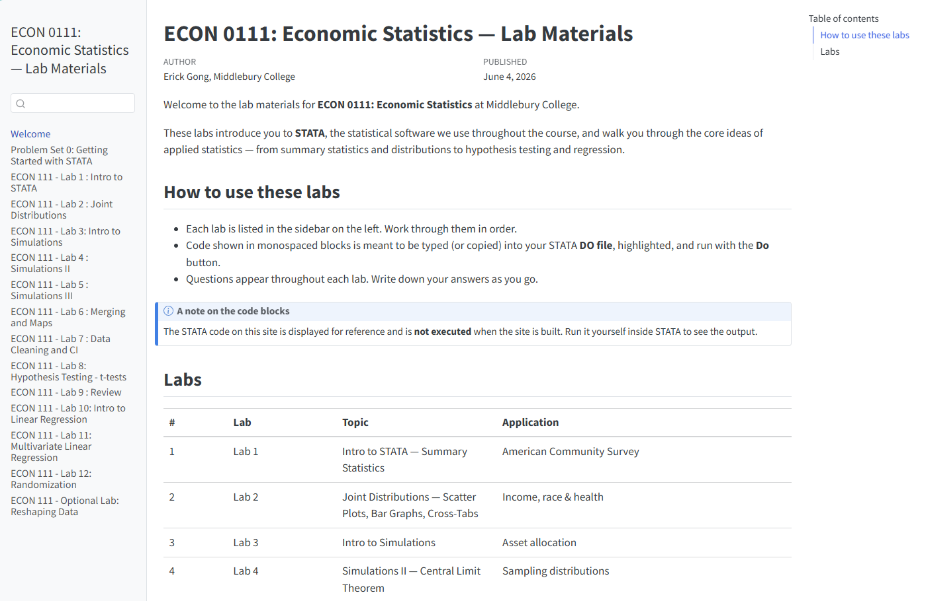
Without Claude, he would have had to learn HTML and JavaScript to put together the site, and it would have been a months-long process which would have left little time for him to evaluate and review the site.
Advice for Faculty
Erick found that the best way to learn how to use AI to help you in your work is to begin experimenting. Since everyone’s use case is so unique, it is difficult to explain or demo what the work is like. He appreciates that Claude can hold information in memory so that the context of his work is not lost each time he starts working with the tool. This allows him to onboard Claude with his own professional guidelines and expectations for the work that he is doing.
I always have a list of ideas that I would like to pursue while teaching and I think what Claude Code is doing is actually allowing me to pursue a lot of these different ideas because it’s not limited as much by time as I am.
Erick’s attitude going into using AI was that he felt it was important for him to learn, and he wanted to make it fun. Between January and May of this year he was learning a lot of new things every day in his work with Claude. However, he is aware and concerned about cognitive offloading - not only for his students, but also for himself. He considers what he might be losing because of this work, but the fact that he is starting to use AI after he has developed and refined fundamental skills and knowledge is very different from students’ experiences of using AI as a novice in their field.
He often guides students through the process of auditing AI’s work by asking “What is that line of code doing? How are you verifying that the actual end result, moving from a raw data set to a clean data set that you can use for analysis, is accurate?”
He notes that working with AI takes patience, but there are a lot of resources available to help you learn. He estimates that he took two weeks in January to really focus on learning the basics, but that window can probably be much shorter now given the way the tools and support have advanced.
He also suggests that faculty think of working with AI as if they are onboarding a new RA or employee in terms of teaching it your rules and guidelines for how you want to work. At the same time - he’s not advocating for AI to replace those roles, but when those roles can’t exist, AI can help assist a faculty member with their work.
Parting Thoughts
The more that I work with AI, …the greater the importance of [my interaction] in the physical world…. I find that I need to talk to people more … It really emphasizes the need to unplug.
Working all day in a digital space can be exhausting and it can be difficult to break away if you feel you’re making a lot of progress. Erick notes that he has developed consistent patterns of unplugging and connecting with people whether through his faith, relationships, learning new things, reading books, or writing things down on actual paper.
You have to nourish the mind, nourish the body and nourish the soul.
Writing and Rhetoric Studies in the Loop: A GenAI Prompt Library – WAC
Posted on August 27, 2026Writing and Rhetoric Studies in the Loop: A GenAI Prompt Library is an open-access, peer-reviewed collection designed to align expert knowledge about writing with the practice of writing prompts for generative artificial intelligence (GenAI) platforms.
Critical AI | Duke University Press
Posted on August 27, 2026Critical AI is an interdisciplinary journal based at Rutgers University’s Center for Cultural Analysis and is affiliated with the Rutgers Center for Cognitive Science. ... Open to ideas born of new interdisciplinary alliances; design justice principles; antiracist, decolonial, and democratic political practices; community-centered collaborations; experimental pedagogies; and public outreach, Critical AI functions as a space for the production of knowledge, research endeavors, teaching ideas, and public humanities that bears on the ongoing history of machine technologies and their place in the world.
The Nexus of Research, Policy, and Practice: Narrative Literature Review of AI Adoption in Future-Proof STEM Curriculum in Higher Education
Posted on August 27, 2026The purpose of this review is to establish how a research, policy, and practice nexus in AI adoption might inform the development of a future-proof STEM curriculum for higher education. For this reason, we reviewed scientific research reports and policy and strategy documents from various global agencies. The review discovered that (a) research on AI adoption in STEM higher education focuses on a narrower theme of education and learning; (b) policy frameworks and guidelines do not address the entire higher education system; and (c) AI adoption primarily focuses on curriculum implementation but provides limited support for curriculum design, development, and appraisal or review. Thus, we analysed the challenges of establishing an effective research–policy–practice system for producing future-proof STEM curricula in higher education and proposed system-wide reforms. We also showed some mechanisms for creating a unified framework for AI adoption.
New open-access journal on AI in higher education launches at CSUSB
Posted on August 27, 2026The International Journal of AI in Pedagogy, Innovation, and Learning Futures is designed as a peer-reviewed forum for research on how artificial intelligence is influencing teaching, learning and institutional decision-making. Its focus is on how institutions can build trust in learning outcomes, academic evaluation and long-term degree credibility.
How AI Is Accelerating Scientific Discovery
Posted on August 27, 2026A feature article from Stanford's Human-Centered AI Institute profiling active research on agentic AI in complex scientific workflows across astrophysics, biomedicine, and other fields. Affiliated faculty are studying both how to use AI agents in complex scientific workflows and how to build frontier models capable of pushing the boundaries of scientific inference, with researchers noting that agentic AI gives scientists a way to scale their expertise across massive datasets and complex experiments.
AI isn’t ready to research itself
Posted on August 27, 2026An agentic system successfully developed concepts from two computer-science papers — but the original authors were not impressed.
Virtual Discussion on GenAI tools in QL/QR Coursework
Posted on August 27, 2026Thursday, September 3 from 2-3pm Eastern, the National Numeracy Network will have a virtual discussion on genAI tools in QL/QR coursework.
Rather than have a designated speaker, we will have time for several folks to briefly share out—for example, a question or an idea—with time for others to respond and converse. We hope you'll come to share and listen to what others have to say!
Register using the short Google Form here.